Agent operations for SAP. Trace every step an agent takes, see what it costs, prove who changed what, and score whether it did the job - in one BTP-deployed console, with your data never leaving your landscape.
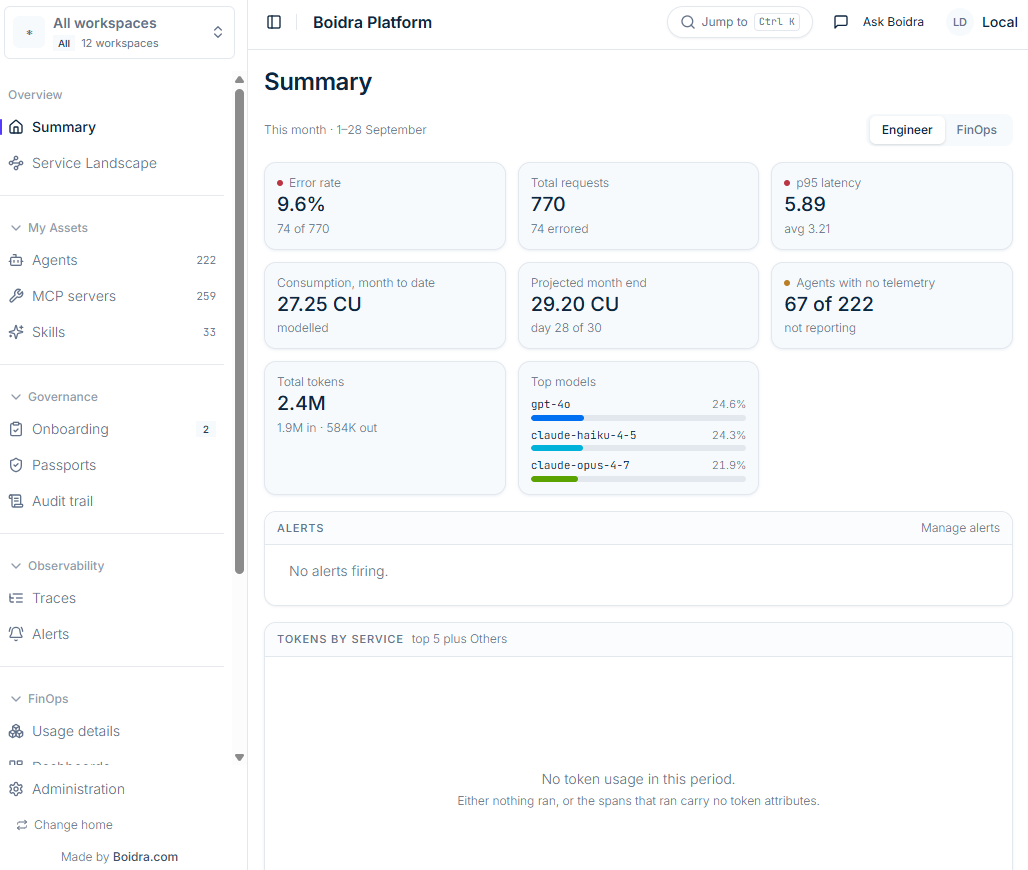
Engineers see error rate, requests and p95 latency. FinOps switches to the same data seen as spend.
Consumption in Capacity Units month to date, and a projection for the end of the month.
Agents that are registered but not reporting telemetry are counted, so blind spots show up.
Agents, MCP servers and skills side by side, with onboarding, passports and an audit trail.
AI Asset Dashboard
As teams build more agents, MCP servers and skills, the hard part becomes knowing what exists, who owns it and whether it is safe to use.
Agents
Custom Joule agents, A2A agents on BTP (Cloud Foundry or Kyma) and domain agents - each with an owner, workspace, environment and version.
MCP servers
Servers that give models tools and SAP data - ABAP source, OData and RFC endpoints, registries - custom-built or third-party.
Skills
Reusable capabilities a colleague runs today and an agent calls tomorrow: triage, spec writing, analysis. Shared across roles and clients.
Wherever an asset was built, it lands in one registry - custom or standard, SAP or not:
Built by your teams
Custom agents and MCP servers deployed on SAP BTP, in Python or Node.js.
SAP Integration Suite MCP Gateway
MCP servers exposed through the gateway, registered with their owner and approvals.
SAP MCP Builder
MCP servers generated from your SAP APIs, catalogued next to everything else.
SAP AI Agent Hub
Agents managed in Agent Hub, visible alongside your custom assets.
Joule Studio
Joule agents and skills built in Studio, tracked through the same lifecycle.
Third-party assets
Existing MCP servers and A2A agents from outside SAP, reviewed before use.
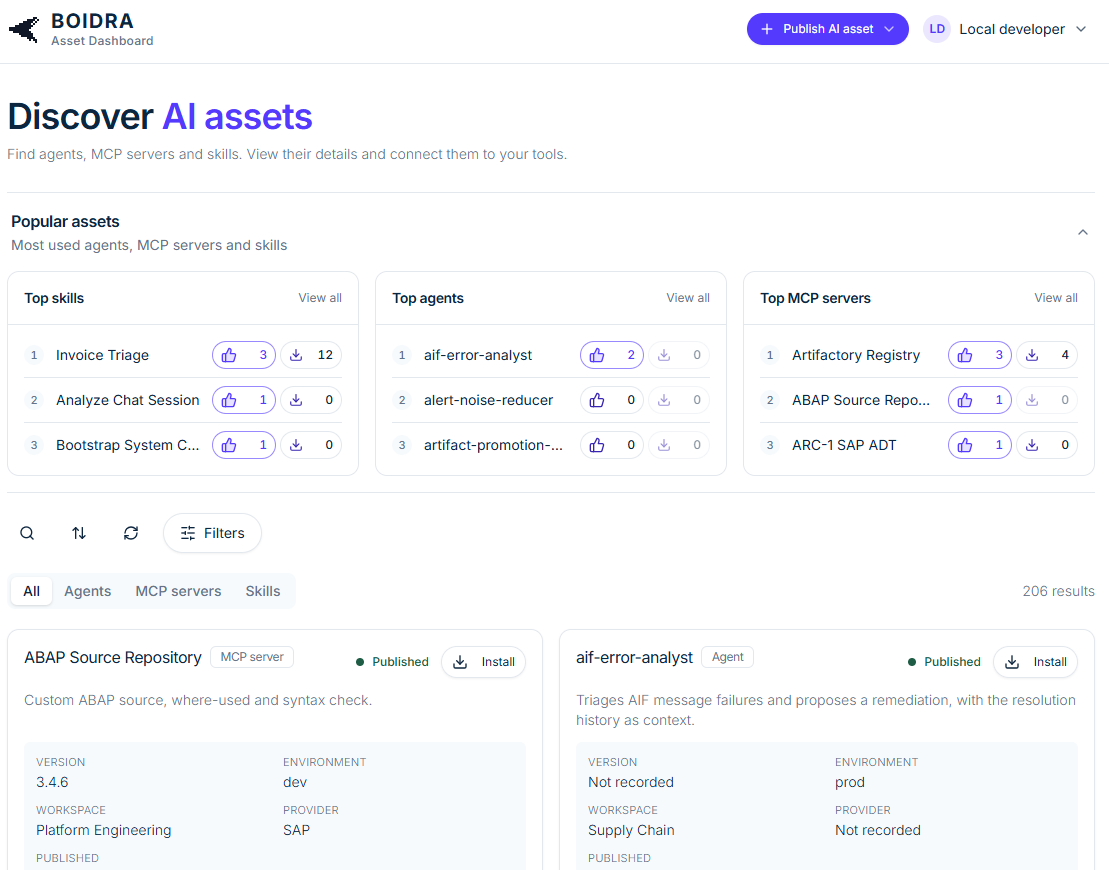
Custom and standard agents, MCP servers and skills in one searchable place - with version, environment, workspace and provider on every entry.
Top skills, agents and MCP servers ranked by likes and installs, so good work spreads between teams instead of being rebuilt.
Set your role and expertise - ABAP developer, finance extensions, integration - and the dashboard suggests the assets that fit, with optional email when new ones arrive.
Connect compatible assets to Joule Work, the Joule digital assistant and other clients in one step.
Nothing reaches the catalogue without passing the review workflow, and every asset reports usage and cost back to the platform.
Sits alongside SAP MCP Gateway, MCP Builder and Agent Hub as the place your teams discover and manage what you have built.
Create
Register an agent, MCP server or skill with its owner, workspace and environment.
Review
Submit for review. Approvers check security, data access and fit before anything ships.
Deploy
Deploy to BTP with telemetry wired in from the first call.
Publish
Publish to the dashboard, where teams can find and install it.
Agents make decisions you can’t see. When something goes wrong - or right - you have no trace, no score, and no way to compare runs. Standard APM stops at the HTTP boundary; it doesn’t understand a reasoning step.
The SAP-native options don’t close the gap yet. SAP Cloud Logging exists, but it wasn’t built to trace and score reasoning steps, and AI-Hub-level observability isn’t fully available. That leaves teams either flying blind, or shipping sensitive telemetry off to third-party tools.
Meanwhile the questions get harder. Finance wants to know what the agents cost. Audit wants to know who changed what. And nobody can say whether last month’s prompt change made the output better or worse.
One agent is easy to reason about. A flock is not - and production is always a flock: agents calling tools, calling models, calling each other across systems. You cannot operate what you cannot see, and you cannot improve what you never scored.
So the platform starts from a single unit: the span. Every step an agent takes - a model call, a tool invocation, a handoff to another agent - emits one. From that one primitive, everything else follows. Stack spans into a trace and you can debug. Price them and you have FinOps. Sign them and you have an audit trail. Score them and you have evaluation.
That is the whole design: instrument once, then answer the operational, financial, governance and quality questions from the same data - instead of buying four tools that each see a fraction of the picture.
Four surfaces over one stream of spans:
It runs as a BTP-deployed app, so observability lives where your business already runs - no context-switching to an external dashboard.
Instrumentation is a dependency and a destination, not a rewrite. You add the boid agent to your service, point it at your Boidra Platform instance, and spans start arriving on the next request - no change to your business logic and no proprietary SDK to code against.
Because it is built on OpenTelemetry, anything already emitting OTel spans can report in without our agent at all - point your existing exporter at the platform endpoint. A2A and MCP calls are traced end to end, so a handoff between two agents stays a single connected trace rather than two unrelated ones.
Agents we build for you arrive instrumented from the first prototype. For agents you already run, expect an afternoon rather than a project.
The platform is native to where your agents actually run: deployed on SAP BTP, wired to Cloud Foundry and your existing destinations, and speaking the open protocols agents use - OpenTelemetry for spans, A2A and MCP for the calls between agents and tools.
That means instrumentation is not a rewrite. Drop the agent in, and spans start arriving - whether the agent is a custom Joule skill, a Gen AI Hub application, or an A2A flock you built yourself.
This is the part that matters most. Boidra Platform keeps all telemetry inside your own SAP BTP landscape - your data never leaves your organization. We do not export traces, prompts or outputs to third-party observability platforms like MLflow or any external SaaS.
For teams handling sensitive business data, that data sovereignty is not a nice-to-have; it is the requirement. It is also why the platform is deployed into your account rather than sold as someone else’s cloud.
Small and medium teams running custom AI inside SAP - the ones without a dedicated AI operations department, who still have to answer for what their agents do, what they cost, and whether they are getting better.
We build it because we need it. Every agent Boidra ships for a customer is developed, evaluated and operated on this platform, from the first prototype through to production.
