
What is SAP Joule?
SAP Joule is SAP’s generative-AI copilot, embedded directly into the flow of work across SAP applications - S/4HANA Cloud, SuccessFactors, Ariba, Concur and more. Instead of learning transaction codes or hunting through menus, people describe what they need in plain language, and Joule responds with information, insight, or a completed action - grounded in their own business data and their role.
What separates Joule from a generic chatbot is context. It is grounded in the SAP Knowledge Graph and SAP Business Data Cloud, so it understands the relationships in your business - an order’s history, an employee’s role, a supplier’s status - before it acts. That grounding is why Joule can execute real transactions safely, not just chat.
Assistants vs Agents: the important distinction
SAP splits Joule into two modes, and the difference matters when you’re planning what to build:
- Joule Assistants are conversational. You ask; they retrieve, summarize, navigate or guide you through a task. The interaction is reactive - you’re driving.
- Joule Agents are proactive and autonomous. They anticipate what’s needed and carry out multi-step workflows across applications with minimal oversight - a Cash Management Agent reconciling bank statements, for example. Agents are the leap from “answer my question” to “do the work.”
SAP ships a growing library of ready-made agents (over 1,300 skills across business functions), and - this is the part most teams miss - you can also build your own. For a deeper look at how the copilot became a network of agents, see How SAP Joule works.
What is Joule Studio?
Joule Studio is SAP’s design-time environment for building custom AI agents, applications and workflows that plug into Joule. It offers both a low-code / no-code visual experience and a pro-code path (with support for tools like VS Code and Cursor), plus intent-based development - describe your goal in natural language and Joule Studio drafts the agent.
There are effectively two generations. The original Joule Studio in SAP Build introduced the skill builder and agent builder. The newer, fully managed Joule Studio adds a zero-infrastructure runtime - no cluster, storage or model management - and embedded orchestration through partners like n8n. We break the two down side by side in Joule Studio Classic vs the new Joule Studio.
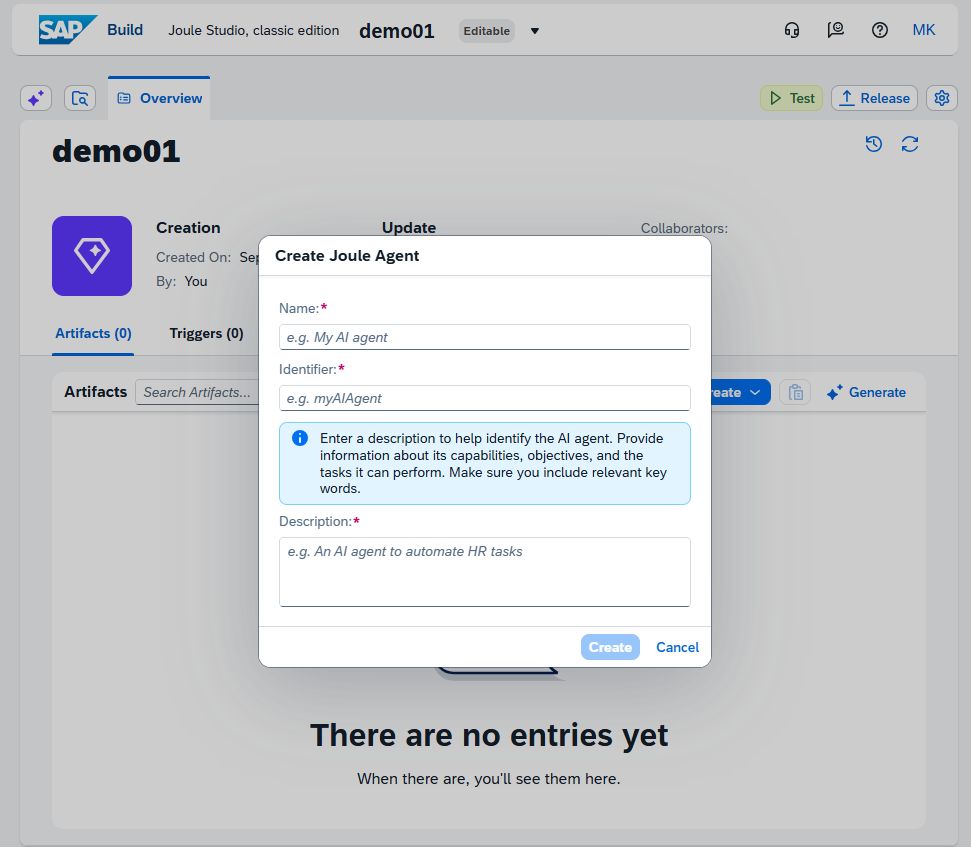
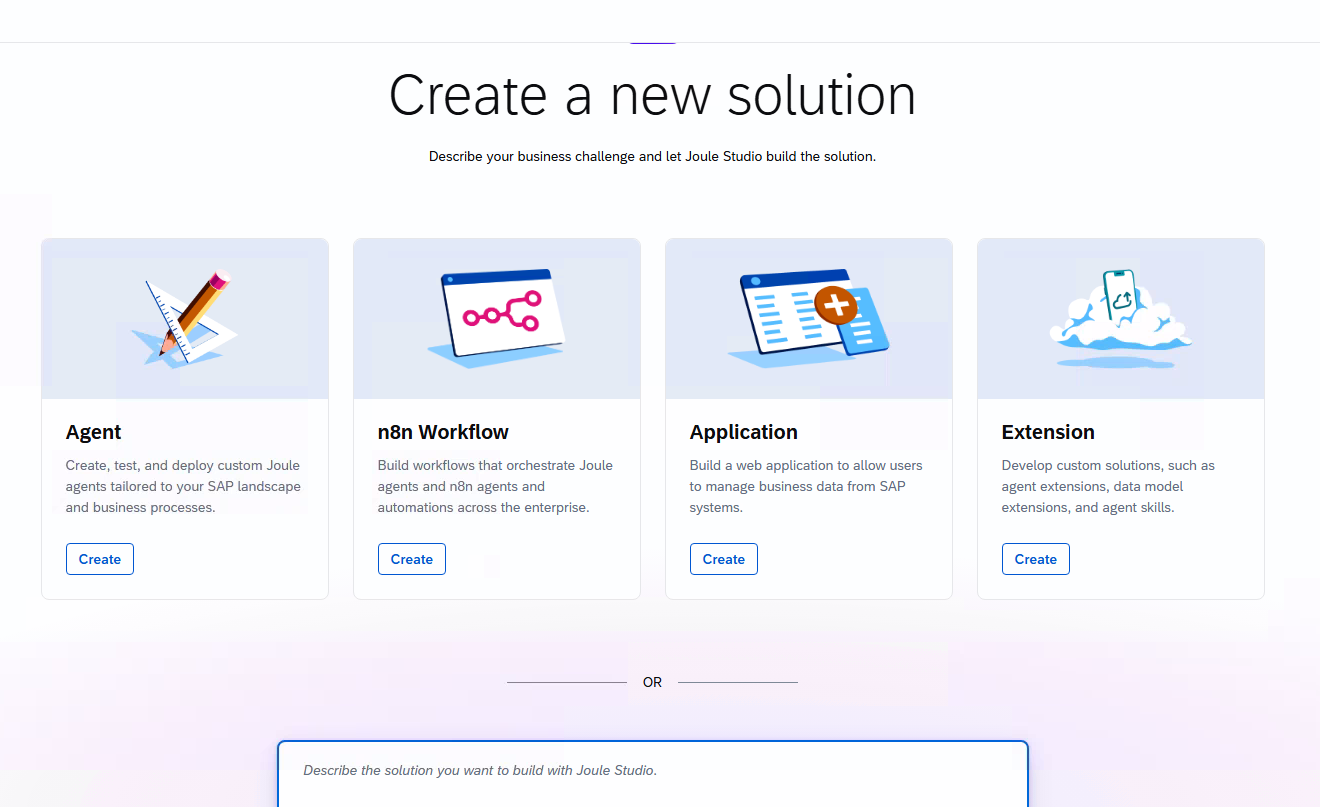
The screenshots make the difference concrete. Classic starts from which artefact do you want to build; the new Studio starts from what problem are you solving, and widens the output beyond agents to workflows, applications and extensions.
The on-premise reality (read this before you plan)
A question that trips up a lot of roadmaps: Joule is cloud-only. It is supported on S/4HANA Cloud (Public Edition from release 2408 onward) and other cloud SAP products, but not on classic on-premise S/4HANA - and it isn’t on the current roadmap for it.
If your core runs on-premise or in a private cloud, that doesn’t shut you out of agentic AI. It means the right pattern is often to build custom agents on SAP BTP - grounded in your data, observable, and interoperable with Joule over open protocols - rather than waiting for a Joule feature that isn’t coming to your landscape.
How Joule connects to everything else: A2A and the Agent Hub
SAP has embraced the open Agent-to-Agent (A2A) protocol. Through the SAP Agent Gateway, Joule Agents can be consumed by external platforms - Google Vertex AI, Microsoft Copilot Studio, AWS Bedrock - and, just as importantly, your own custom agents can interoperate with Joule instead of living in a silo.
Governing all of this is the SAP AI Agent Hub: a vendor-agnostic registry and command center for discovering and governing agents, LLMs and MCP servers across your landscape. For the wider map of SAP’s AI stack - AI Core, AI Launchpad, the Agent Hub and Gateway - see the SAP AI landscape overview.
Build custom now, grow into SAP standard later
Here’s the strategy we recommend to SAP teams. You don’t have to choose between “wait for SAP-standard Joule agents” and “build something custom.” Because everything speaks A2A, you can build the agents you need today - scoped to your process, wired to your systems, observable from day one - and move into SAP-standard solutions like Joule and the Agent Hub when they fit, with no rebuild and no lock-in.
That’s exactly what Boidra does: we build custom SAP Joule agents and multi-agent systems, instrument them with telemetry and scoring, and keep them interoperable with the SAP standard as it evolves.
Frequently asked questions
What is SAP Joule?
SAP Joule is SAP’s generative-AI copilot, embedded across SAP applications such as S/4HANA Cloud, SuccessFactors, Ariba and Concur. Users interact in natural language to retrieve information, get insights and run transactions - grounded in their SAP business data and role.
What is the difference between Joule Assistants and Joule Agents?
Joule Assistants are conversational: you ask, they answer or guide you through a task. Joule Agents are proactive and autonomous - they anticipate needs and execute multi-step workflows across SAP applications with less manual oversight. Agents are the next step beyond the assistant.
What is SAP Joule Studio?
Joule Studio is SAP’s design-time environment for building custom AI agents, apps and workflows that plug into Joule. It offers low-code and pro-code paths, intent-based development, and grounding in SAP data. The newer managed Joule Studio adds a zero-infrastructure runtime.
Is SAP Joule available on-premise S/4HANA?
No. Joule is supported on SAP S/4HANA Cloud (Public Edition from release 2408 onward) and other cloud SAP products, but it is not available for classic on-premise S/4HANA and is not on the current roadmap for it. On-premise landscapes typically extend AI via SAP BTP and custom agents instead.
Can I build my own custom SAP Joule agent?
Yes. You can build custom agents in Joule Studio, and - because SAP has adopted the open Agent-to-Agent (A2A) protocol - external and custom agents can interoperate with Joule. This lets you build a custom agent now and connect it into the Joule ecosystem when it fits.
How does SAP Joule connect to other AI platforms?
Through the SAP Agent Gateway and the A2A protocol, Joule Agents can be consumed by external systems such as Google Vertex AI, Microsoft Copilot Studio and AWS Bedrock - and custom agents can delegate to or extend Joule.
Build with Joule
Extend SAP Joule with custom agents
Custom, observable, A2A-ready - built to grow into the SAP standard.